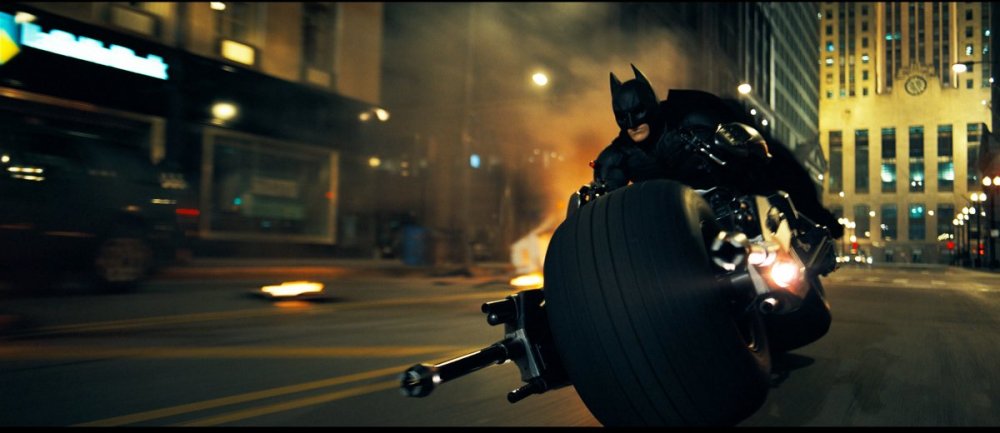
Christopher Nolan directs Christian Bale, Gary Oldman, Michael Caine, Morgan Freeman, Cillian Murphy, Liam Neeson, Heath Ledger, Aaron Eckhart and Tom Hardy in this trio of Batman stories that try to bring a degree of real world logic to the millionaire orphan turned masked vigilante mythology.
For all the snideness over the established vanilla Marvel studio movies being more consistent than the less certain, yet more flavourful DC Universe movies – let us not forget the most critically acclaimed comic book series came from DC and wrapped up only just five years ago. For all the mass market love the True Believers flicks get, it is blockbuster auteur Christopher Nolan’s take on the Batman that still has the bragging rights. Most likely as the director married his distinctive strengths with strong material. Nearly all his back catalogue are intricately assembled tales of troubled men who go to fantastical lengths and precise methodology to find unobtainable peace in vengeance. Men who try to bend the world to fit their will, and find the world violently fights back if you alter the accepted reality. Loners trapped in psychological labyrinths, often partly of their own making, that attract antagonists who lack the emotional connections that forced the “hero” into the chaos in the first place. About artists whose masterwork and collaborations are intangible rather than creative; whether it be creating the perfect illusion, an indetectable synthetic dream reality, a new hope for dying humanity, solving a mystery or ridding a city of crime. Sounds like the perfect director for the Caped Crusader to me.
How do I feel about a real world Batman? Outside of The Dark Knight I’m not sure it is achieved. Batman Begins (with its Tibetan training montages, CGI monorails of death and the trippy Scarecrow’s fear hallucinogenics) may talk a good game but falls back on imagery that wouldn’t feel out of place in the Burton or Schumacher way less grounded takes. You get the feeling the ad infinite jokey lines about the cool car, interactions with kids where Batman hands over toyified tech and Katie Holmes’ casting are studio enforced, with one eye on four quadrants, action figure sales and a TV spot that work as well as Batman Forever’s did a decade earlier. While Rises has the unenviable job of topping and wrapping up the series only without the Joker, Rachel or Two Face at its disposal. Leaving Nolan the option to go big or go home. We close this more ‘believable’ take on Gotham with Chris Foss inspired sci-fi imagery, as geometric flying machines chase future tanks down streets, and Occupy Wall Street wish fulfilment is taken to nuclear levels.

I guess by real world what we actually get is a Batman series that in the main is shot on location rather than soundstage. Where the technology and logic is still fantasy but at least has the authenticity of a decent explanation to it. We now know where he gets those wonderful toys – military prototypes his company invented, too expensive to sell onto the army to protect the troops. A Gotham where actions have reactions, all characters are emotionally motivated, flawed and most importantly affected. For example; If straight arrow Jim Gordon fakes his death to help snare the Joker, fine… but then his wife leaves him for putting her through the emotional strain and he feels corrupted by lying to the city. So let’s agree on ‘believable’ in that you are impressed as to how the human domino rally knocks together neatly rather than the size of the fake explosions, the gaudyness of the colour scheme chosen for the villian or the scale of the gothic pornography in the set design. Let’s agree on that definition rather than pretend the trilogy is any great act of verisimilitude just because there is a lot of natural daylight.
But what Nolan does bring is a clean, clear approach to his both impressively complex storytelling and especially to his action. A terrifying kinetic logic. A problem solvers zeal at setting physical, mental and ethical conundrums for his superhero to solve, and a pace where the viewer just has to keep up, there is no chance of guessing ahead at this muscular pelt. We get hints of this in Begins. It is a talkier film than most summer blockbusters, the action comes in short, unpredictable, unsustained bursts. More interested in establishing iconography than getting you to grip your armrests, it is still effective.
Yet when we hit The Dark Knight not only does that action become sustained but also takes on a lateral thinking aspect as the situations Bats is thrown into by the chaotic but effective Joker can’t be solved by punching the hardest or having the fastest fantasy vehicle … until they eventually can for a satisfying full stop. Who do you rush to save if you can’t save both parties from two separate equidistant ticking time bombs? How do you stop a SWAT team from shooting hostages dressed as captors while still disengaging the captors dressed as hostages? The bang and blast and bumps are rollercoaster effective but the Joker’s mind games are what elevate the action from mere destructive kinetics. Game theory over pyrotechnics, while still delivering both.

The Dark Knight Rises spectacle is a little less certain. We have the attractive kink of a Catwoman bending, crouching, riding and high kicking… married with the muscular destruction of both Batman and Gotham by Bane. Once again it is how logically Nolan presents the breakdown of a city that is the WOW factor here rather than any particular fight choreography or vehicle chase. The kangaroo court trials of the rich, the ransacking of the penthouses, the organisation of the invading League of Shadows 2.0 all convince in their brevity. And then we have the strange interlude where a broken Bruce Wayne rebuilds himself in a literal pit of a third world prison. Despair made brick and bars, where he needs to reinvigorate his hope and overcome his fears to make the “impossible” ascent out to freedom. Just keep climbing the wall’s brickwork, mate, don’t worry about leap from teasing platform to teasing platform. You’d be out a lot earlier that way. Not many summer tentpoles dare put their hero out of action for an hour so he can live through an allegory. But Nolan has that ironic freedom, and from a storytelling point of view Batman has to be waylaid somewhere else for Gotham to be brought quite so close to the brink. So it might as well be the pit prison in Kurdistanigulaguraville.
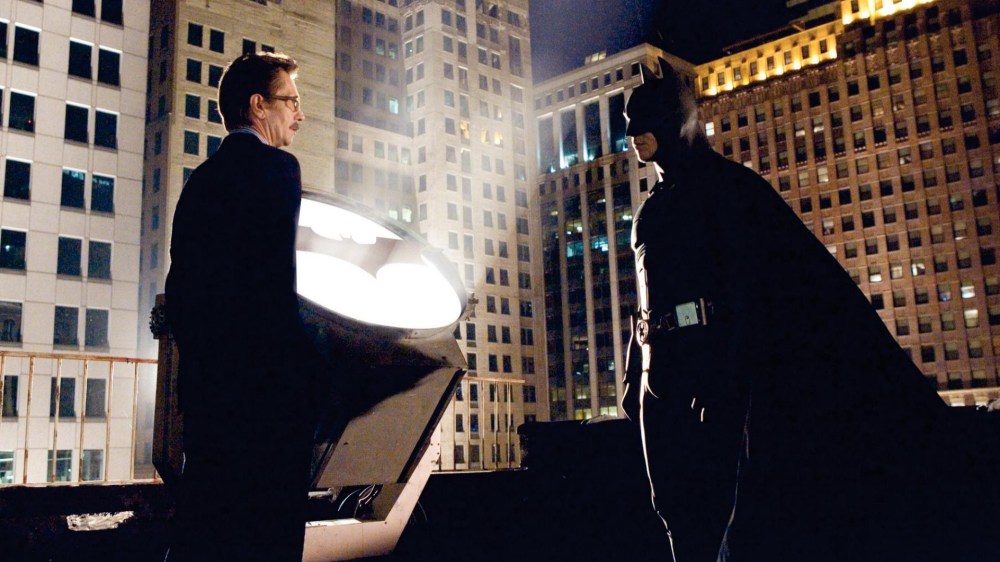
The other thing Nolan brings to the table is that his burgeoning artistic reputation attracted a stellar cast. Batman Begins came off the back of the cash generating Ocean’s 11 series at Warner Bros and I can’t help but think they had as much an influence on these films as your oft openly referenced Heats and Godfathers. Knowing the trouble the franchise had previously endured with constantly quitting Batmen… the studio think should have been why not build the foundations of the series around a less bankable star (Bale) and then flood the expansive plot with quality actors in support. Lend the project some prestige, tap into the box office power of many, rather than one or two guest villians hidden behind masks. If this was the theory it worked a treat. I’m going to spend the rest of the blog looking at the cast and characters as that seems the healthiest way of breaking down such a well engineered series of films. By its most recognisable individual parts.
Bale as Batman is troubling. He is certainly the best actor, bar maybe Keaton these days, to take on the cowl. There is diverting shenanigans in how his public image Bruce Wayne is just him reprising his idiotically manic Patrick Bateman from American Psycho. His behind closed doors Master Bruce is actually a lot of fun too, his warmth towards Alfred charms and his internal conflict mirrors the doubts comic book Batman often wrestles with in rectangular text bubbles. His Batman itself though is a mixed bag. The growling voice, awful at times. He appears to lack any control. If anything the constrictive suit is the only thing holding him back from having a full on paddy in the most stressful situations. As the series moves along it is noticeable how little time outwith the big set pieces the cape and cowl are even glimpsed. If it wasn’t for the persuasive hero theme score, would any of his adventuring feel heroic? Giving Bale his due, he is no Kilmer shaped charisma vacuum and he resurrects the icon from Clooney’s “Rubber Lips” fiasco but often you wonder if he was the best available man for the job. And that’s from a fan of his acting style who licked their unrubber lips at the prospect of Bateman does Batman when it was announced almost twenty years ago. I guess the one true success of his Dark Knight is he defines Bruce Wayne, Master Bruce and the Batman as three separate, almost paranoid schizophrenic personalities.
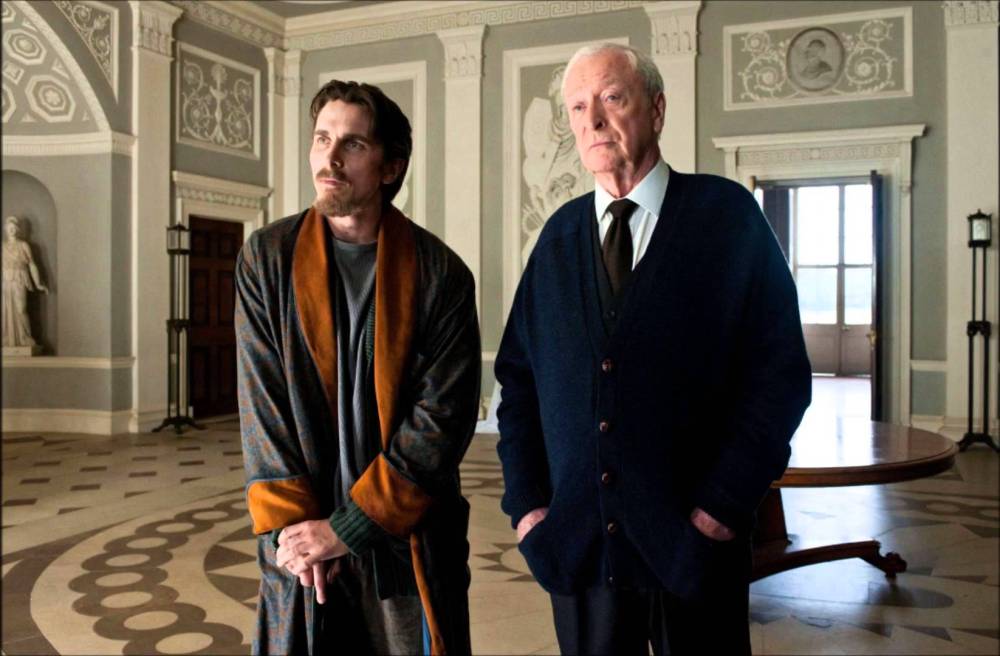
Like I said Bale’s Bruce comes alive next to Caine’s Alfred. A bitpart which lesser directors would toss out to the most affordable elderly Brit available, gets given to one of our finest living movie stars. His chemistry with Bale is palpable. He brings humour, paternal concern, depth, mischievous complicity and tragedy to the trilogy. It is no surprise that, way above Ledger’s showy ramblings and Hardy’s totalitarian speeches, the butler gets the best monologue “Some Men Just Want to Watch The World Burn” and the most emotionally satisfying coda.
Freeman meanwhile gets a pithy role, knowingly reprising a variation on his Shawshank’s Red. A man who can get you anything, only this time based in the R&D department of Wayne Enterprises rather than a prison woodshop. Like Alfred, he classily delivers the zingers when everyone else is taking proceedings too seriously. Only he feels shortchanged in the hurried last act of the last film.
One of the enigmas of the series is why Katie Holmes abandoned ship as love interest (and Assistant DA) Rachel Dawes, for what was clearly going to be her character’s meatiest moment. She is pretty and effective enough in Begins to convincingly distract Bruce Wayne from his oblivion. So why was Maggie Gyllenhaal shipped in to play the same character come Chapter 2? She is a better actress, indisputably, but the swap jars. Her death scene though is fantastic and deserved a Best Supporting nod for that run of Oscars as much as anything else nominated. Maybe Nolan didn’t see Holmes as making such an affecting presence in such a full-on scene?
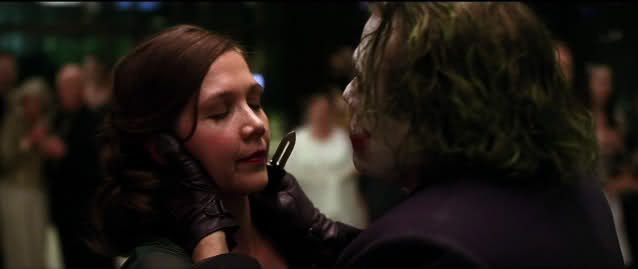
And we’ve got this far and are yet to discuss a villian. That shows you how far Nolan successfully moved the focus back to Batman after four films where the baddies were the top billed names. Nolan resets the series to a narrative where Bruce Wayne is concentrated upon rather than sometimes sorely cameoing in his own baddie pantomimes. Liam Neeson essentially plays a plot twist for the first part. His mentoring as the hard taskmaster Ducard is more convincing than his antagonism as the real Ra’s al Ghul. It is a bitty part that Neeson could easily sleepwalk through. Cillian Murphy makes a far more lasting impression as nightmare inducing psychologist Jonathan Crane AKA The Scarecrow. One of the broadest elements of Begins, he adds a real menace and mania. His continuing cameos throughout the full story are appreciated and his assumed survival adds to the entire project’s sense of scale and epicness. A character as nasty and devious as the Scarecrow recurring and at large, reveals a world with compromises even in its “happy” resolutions. A world that enticingly carries on even after the final shots.
Aaron Eckhart is fantastic as Harvey Dent. You genuinely believe in him, that he can clean up Gotham, that he can replace the Batman as the symbol the city can rally behind. We get career best work from a square jawed, flaxen haired actor who often feels like nobody’s first choice in his own lead roles. His Two Face doesn’t really receive enough cat swinging room to impress quite as much and I do wonder whether there was more explorable mileage in keeping him alive rather than The Joker at the end of Part 2. We’ll never know.

“You want to see a magic trick?” Let’s be honest, it appears Nolan enjoys introducing his characters more than putting them back in their boxes. Bale becomes Batman twice in three films, while Nolan extends The Dark Knight and The Dark Knight Rises both to give us double bonus twist origin stories (Two Face and Robin) and only Ledger’s The Joker comes, out of nowhere, fully formed. He offers conflicting lies about how he got his scars, leaves calling cards and creates his own villians. Who is this guy? Who is Jack Nicholson? What a great first meeting… The mob bank robbery where he plans to kill off his gang the second they serve their purpose during the crime. It is one of those truly brilliant scenes that could be a stand alone short movie in its own right. Ledger’s jittery, rasping delivery is both terrifying and hilarious. Fiddling with the batteries for his faulty detonator as he walk away from a partially destroyed hospital, it all feels like something from a Tex Avery cartoon as much as a slick crime epic’s big bad. It is the greatest piece of superhero movie acting, recognised after his death universally as such. Revel in it.
Leaving Tom Hardy with ever so big boots to fill as our final key antagonist. In terms of physicality he convinces as a man who can overwhelm the Bat. And Nolan invests him with a similarly great debut sequence, a stunningly realised mid air plane hijack. But there are quibbles. That sound design where the rest of the soundtrack fades behind his convuluted, mechanical growl is off putting. Whether it is a last minute patch to cover up how indistinguishable the original sound mix was when he spoke, or artistic licence to suggest how dominant Bane is over all he encounters, it takes the viewer out of the movie. Then after destroying all we hold dear, he fades into the background somewhat. And eventually we get the revelation he isn’t the true mastermind of his siege. You start to question where the agent of chaos ends and the mere lackey henchman begins? At what points is Bane, a supposed genius, taking orders? What words are his? Is he even the one mouthing them behind that mask? That twist, that he is not the League of Shadows ultimate leader, is predictable but so blundered through we don’t get to absorb the logic of the new information. A rushed, garbled ending after such blinding clarity in the preceding 7 hours somewhat weakens the grand arc.

The Dark Knight Rises biggest risk is Hathaway as Catwoman. But she nails it. Slinky, treacherous and troubled by a wavering conscience – it is bad girl bit of vamping that genuinely surprises given Hathaway’s somewhat frilly star image. She makes a perfect sexual foil for Batman and her moments of heroism and naughtiness feel like the most organic parts of a jumbled third movie. Equally Gordon-Levitt’s rookie detective who solves Batman’s secret and leads the resistance is a treat too. The revelation that he is this realities’ Robin in the last few minutes is a gorgeous bit of fan service. In all honesty a Nightwing movie with Levitt would be a must see for me. Given that the new older, back out of retirement incarnation of Batman doesn’t massively contradict anything that has happened in Nolan’s trilogy… could we not have older Robin return in the form of this established piece of inspired casting? Please?
If I am going to give Man of the Match to anyone though it’ll be Gary Oldman’s superlative take on Jim Gordon. Usually he is happy enough as the villian in these endeavours, yet here, way against type, the British thesp quietly provides the Nolan extravaganzas with their dignified heart and soul. And in a part, that like Alfred, can often be dumped into the lap of far lesser talents. When we talk of Nolan’s trilogy being more realistic, really we are talking of Oldman’s warm and direct interactions with the freaks and the fucked up that gifts them all a convincing human counter balance. From the moment when he places a comforting arm around young Bruce on the night his parents died, to the giddy joy he takes in putting cuffs on the Joker (“Could you please just give me a minute?!”), to his baffled eventual realisation as to who the masked avenger he has worked beside for a decade is… Oldman effortlessly sells it all.

Though not quite as consistent as the excellent The Dark Knight, on the whole the trilogy is about as good as modern franchise fare gets. It is unfair to moan that all three films lack the unhindered by studio politics focus and hauntingly brilliant work by Ledger that their highwatermark individually reaches. These are the finest crafted Batman movies. As a kid who was exactly the right age in the summer of 1989 you’ll never beat the nostalgia I hold for Burton’s pair… and as someone who still religiously reads the comics I openly hold that Snyder’s current messy films are the most accurate and therefore sate my strange yearn for fidelity. But Nolan is the only auteur to turn in a Gotham movie that you could pop on for someone who has never even heard of the Batmobile or Dick Grayson, and they’d still walk away thinking they’d seen a masterpiece. And he did it at a point where big budget fare was getting blander, dumber and less star orientated cementing the notion that his name on a project guarantees intelligence, ambition and quality.
8/10/8