Topkapi (1964)

Jules Dassin directs Melina Mercouri, Peter Ustinov and Maximilian Schell in this Technicolor heist film set in Turkey.

25% exotic milf Melina Mercouri vamping it up. 25% gentle comedy fluff. 25% travelogue filler. 25% heist film. No portion is all that bad but if you’ve quite reasonably bought a ticket for an intensely executed robbery as in Rififi then Topkapi can demand a fair amount of patience. When the dangling museum set piece that was expertly homaged in De Palma’s Mission:Impossible does begin, it is more than worth the wait.

6

Check out my wife Natalie’s Point Horror blog https://cornsyrup.co.uk

We also do a podcast together called The Worst Movies We Own. It is available on Spotify or here https://letterboxd.com/bobbycarroll/list/the-worst-movies-we-own-podcast-ranking-and/

The Girl (1968)

Márta Mészáros directs Kati Kovacs, Teri Horvath and Juhász Jácint in this Hungarian youth drama where an orphan reaches adulthood and visits the mother who abandoned her at their farm.

A pleasing message in the bottle from Eastern Europe’s recent past. Melancholy, hip, sensitive. A lonely young adult experiences rural life and glimpses the frozen-in-time world her mother must have lived in when she was her age. What is fascinating is Mészáros then shows us the single girl returning to her lonely life as a factory worker in Budapest and just how much is the same. Rip-off Beatles bands play bastardised pop hits about freedom, boys want girls for one thing only getting romantic once rejected, money controls even small interactions like swimming wild or meeting a stranger for lunch. This isn’t a spectacular film, not even particularly cohesive, but it has stayed with me over the last week. The well composed wide shots giving way ever so occasionally to impactful moving close-ups, the minimalist storytelling that hints at meaningful depths. An enigmatic ending. I might retry this soon if the effect proves lasting. Modest but emotionally mature.

6

Check out my wife Natalie’s Point Horror blog https://cornsyrup.co.uk

We also do a podcast together called The Worst Movies We Own. It is available on Spotify or here https://letterboxd.com/bobbycarroll/list/the-worst-movies-we-own-podcast-ranking-and/

Guilty As Sin (1993)

Sidney Lumet directs Rebecca De Mornay, Don Johnson and Stephen Lang in this courtroom thriller where an ambitious attorney takes on the client from hell – a manipulative ladykiller with his eyes on her as his next doomed plaything.

Lumet slumming it, seemingly better than the Larry Cohen script he is working from…. And yet too stodgy to have any of the sleazy larks the high concept schlockmeister would have had with it if he just directed it himself. For an erotic thriller, there’s minimal sex. The most fruity aspect is underdeveloped – rich wives will seemingly do anything for Johnson’s gigilo once he ensnares them. How does that work? Is the dicking that good? Or do his insidious mind games turn them all into self destructive slaves? A better film would relish the prospect of exploring this subplot further… even have De Mornay come closer to becoming one of his near brainwashed Stepford Conquests. Yet after some malicious flirtation and half hearted evidence planting, we end up with a stunt finale that feels abrupt and inconclusive. De Mornay is miscast in the hero role… she is so much better as ice queen and life wrecker, seeing her on the other side of the equation feels wasteful. She visibly struggles. In one scene Johnson makes the world’s most aggressive sandwich, seemingly relishing the mayonnaise on his fingers more than the ladies he grapples with. Stephen Lang is stuck in the nagging boyfriend role, sporting a Seventies porn moustache and perm that must have some implied significance that has long since lost its power. Not even workable as throwaway airport novel pulp. Can’t believe I’ve somehow chosen to watch this twice in my movie watching life!

3

Check out my wife Natalie’s Point Horror blog https://cornsyrup.co.uk

We also do a podcast together called The Worst Movies We Own. It is available on Spotify or here https://letterboxd.com/bobbycarroll/list/the-worst-movies-we-own-podcast-ranking-and/

La Vérité (1960)

Henri-Georges Clouzot directs Brigitte Bardot, Sami Frey and Charles Vanel in this French courtroom drama in which a wayward girl’s sex life is put under the microscope after she kills her lover.

A mixture of French courtroom procedure and flashbacks through the accused’s life, this works best as a youth movie first and a crime movie second. I think most people approach La Vérité, owing to the title, as a Rashomon investigation into people’s perspectives on a murder. I think that kinda misses the point and does the narrative a disservice. We are never meant to doubt the sincerity of Bardot’s unfortunate Left Bank sex kitten or mistrust her testimony. The predicament is that she is being judged by a conservative, hypocritical, aged patriarchy unwilling to see the humanity in her story. They want to blame her; her youth, her femininity, her allure, her freedom, her rejection of social norms. Her guilt is she is living a way of life of they do not want to admit to… to allow into evidence. Tragic and doomed Dominique is modernity… for all it naivety, faults and insecurity. The conservative system has very little heart for her plight, but also can not be seen to validate the permissive changes that the Sixties will bring. The Truth is that French values are shifting, but the accused has broken the rules too early to be forgiven by the state. Bardot here is a more calamitous peer to Julie Christie’s Darling. The worst case scenario of what might happen to a young girl who doesn’t want to submit to outmoded expectations of her. Even as she falls from rebel without ambition to martyr, she retains her desirability. We are meant to lust after her, even as men use her and assault her emotions. Perhaps we are meant to conclude that how can someone so desirable and so vivacious be treated as disposable? While Dominique is equally capable of wanton behaviour Clouzot shifts our sympathies from her less and less in the second half. Her position is far more precarious than those she commits her small transgressions against. The film does have pacing issues, but some of the best scenes (an all-night spurned lover staking out a hotel springs to mind, Paris shutting down and coming back to life) work because of their indulgence.

8

Check out my wife Natalie’s Point Horror blog https://cornsyrup.co.uk

We also do a podcast together called The Worst Movies We Own. It is available on Spotify or here https://letterboxd.com/bobbycarroll/list/the-worst-movies-we-own-podcast-ranking-and/

Psycho II (1983)

Richard Franklin directs Anthony Perkins, Vera Miles and Meg Tilly in this mystery sequel to Alfred Hitchcock’s motel murderer classic.

Norman Bates is out… but is he cured? A series of murders spring up around the motel and a sexy waitress enters his life. Franklin affectionately reworks all the original’s iconic shots, locations and thrills. Each homage is given a fresh, alternative spin. It really is a very reverent yet inventive revisit to cinema heaven. Perkins gives probably his career best performance as the mentally fragile, eager to restart his life nutter. You are completely on his side, even when it seems highly likely that old habits die hard. This could have been an absolute car crash, and was somewhat treated as such offhand by critics still wearing their widow’s weeds so soon after Hitch’s passing, but Psycho 2 has aged up quite marvellously. Sure, it was never going to match 1960’s Psycho but it is a trashy, histrionics and camp little whodunnit in its own right.

8

Check out my wife Natalie’s Point Horror blog https://cornsyrup.co.uk

We also do a podcast together called The Worst Movies We Own. It is available on Spotify or here https://letterboxd.com/bobbycarroll/list/the-worst-movies-we-own-podcast-ranking-and/

Storyville (1992)

Mark Frost directs James Spader, Jason Robards and Joanne Whalley-Kilmer in this erotic courtroom drama where a front runner in a New Orleans political campaign begins unravelling various mysteries he is connected to.

From the other creator of Twin Peaks. This has some lurches into strangeness, kinky sex scenes and way too many subplots. Its at its best whenever violence unpredictably arrives and destroys the genial facade of a fairly rote potboiler. Probably needed another twenty minutes runtime so the impact of the crowded twists can live up to the notably lived-in steamy atmosphere. Has a nicely discordant score from Carter Burwell.

6

Check out my wife Natalie’s Point Horror blog https://cornsyrup.co.uk

We also do a podcast together called The Worst Movies We Own. It is available on Spotify or here https://letterboxd.com/bobbycarroll/list/the-worst-movies-we-own-podcast-ranking-and/

The United States Vs. Billie Holiday (2021)

Lee Daniels directs Andra Day, Trevante Rhodes and Garrett Hedlund in this musical biopic of jazz singer Billie Holiday and the FBI’s destructive hounding of her after she sang Strange Fruit.

Andra Day’s blistering, brave and sensual lead performance means this always out swims its flaws. There’s a ropey framing device that is quickly all but abandoned and the production values often suffers a blatant cheapness in the post war period set dressing. Lee Daniels is an awkward filmmaker, yet I appreciate his distinctive luridness. There is a pleasing amount of nudity from Day and Rhodes and their sex scenes have undeniable heat. Yet he does stumble head first through the cliches of the modern music biopic, more than once in a few cases. Which is frustrating as there is a strong and tight tale from history here that would be a cinematic romantic thriller in its own right even before you factor in Holiday’s legendary and revolutionary status within the entertainment world. A mixed bag but I kinda forgave it for being half flat and half clunky as I certainly was never bored watching Day.

6

Check out my wife Natalie’s Point Horror blog https://cornsyrup.co.uk

We also do a podcast together called The Worst Movies We Own. It is available on Spotify or here https://letterboxd.com/bobbycarroll/list/the-worst-movies-we-own-podcast-ranking-and/

Dheepan (2015)

Jacques Audiard directs Antonythasan Jesuthasan, Kalieaswari Srinivasan and Claudine Vinasithamby in this French drama where three refugees from Sri Lanka arrive in France as a fake family.

Audiard again embraces an outsider’s perspective to modern French criminality. The slight problem here is the movie proves far more fascinating when it about the everyday illegal immigrant experience and how these particularly well acted and complex trio begin to form attachments. Once all out project gang war breaks lose, the movie not only goes for sizzle over steak but at least one of the makeshift family is all but forgotten about. A movie this gritty and uncommon definitely deserves praise but that traditional action finale counterintuitively ends things on a low.

7

Check out my wife Natalie’s Point Horror blog https://cornsyrup.co.uk

We also do a podcast together called The Worst Movies We Own. It is available on Spotify or here https://letterboxd.com/bobbycarroll/list/the-worst-movies-we-own-podcast-ranking-and/

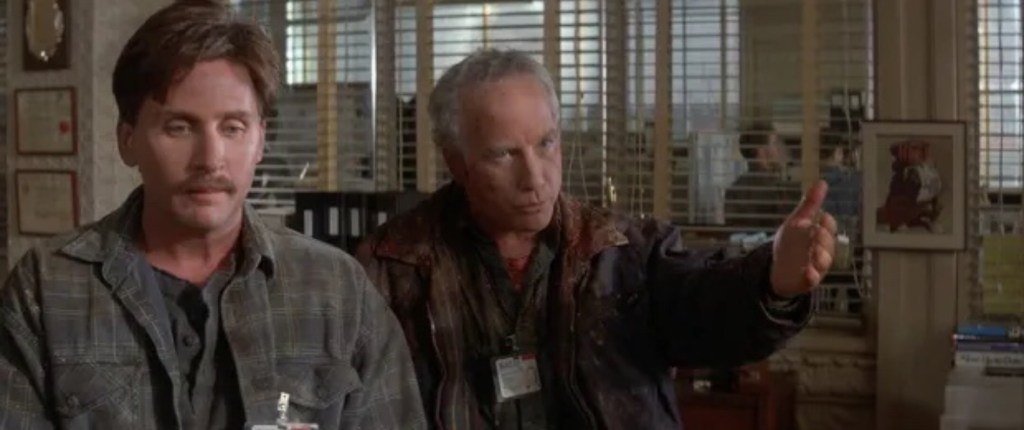
Stakeout (1987)

John Badham directs Richard Dreyfuss, Emilio Estevez and Madeleine Stowe in this cop comedy where a detective falls for the target is he spying on from across the street.

PG nudity. Comedy bulldog. Moustaches. Many a happy afternoon was spent watching Stakeout as a kid. The emphasis was on pranks and larks over deaths and chases. Though Badham does effectively deliver some full fat peril at the bookends of the narrative. Stowe is the standout in an impressive ensemble even if her accent wobbles a little during the shoot. I’m not sure if they over emphasise her character’s Latino heritage just to justify the banging Gloria Estefan hit from the tie-in soundtrack? Held up just fine.

7

Check out my wife Natalie’s Point Horror blog https://cornsyrup.co.uk

We also do a podcast together called The Worst Movies We Own. It is available on Spotify or here https://letterboxd.com/bobbycarroll/list/the-worst-movies-we-own-podcast-ranking-and/

Julie Christie Round-Up

In Search of Gregory (1969)

Peter Wood directs Julie Christie, Michael Sarrazin and John Hurt in this romance movie where a British heiress visits her father’s villa in Milan and becomes sexually obsessed with his elusive house guest who she keeps failing to meet.

A frippery. Greenlit as Christie wanted to be in the same country as then lover Warren Beatty, who was in Italy for some other long forgotten project. John Hurt gives a strange but indelible performance as Christie’s incestuous bisexual brother. Otherwise this is is all mouldy Italian New Wave afterthoughts and stale Swinging Sixties stylings. It is genuinely a shock how long they drag out and string along such a thin concept, but there’s minimal entertainment value. If you haven’t come to ogle Christie or Sarrazin in expensive fashions than there’s palpably not much here. Reminds me of the kinda movie they used to project on the walls of club nights in my twenties. Evoking some abandoned sense of style and glamour but not obtrusive enough to distract from the DJ.

4

Demon Seed (1977)

Donald Cammell directs Julie Christie, Robert Vaughn and Fritz Weaver in this sci-fi horror where a supercomputer hijacks a woman’s automated home and terrorises her.

A beguiling little freak out. The first half hour is testing, really staid and dry. But then once the villain, a prescient mixture of Alexa and HAL, locks Julie Christie in with minimal options for escape we take a strange psycho-sexual road less travelled. Cammell, a former artist who co-directed Performance, shows his artificial intelligence monster spying, torturing and coercing his infatuation. It is explicitly a male being, he stares at Christie in the nude, strangely lingering not on her breasts, legs, bum, muff or face but her arms and her stomach. The things Proteus IV desires. His own limbs, a womb. The unsettling insemination and cyber bondage sequences are queasily intrusive. For pure horror fans there is a geometric shape shifting sentry that pinches a man’s head clean off. For the arthouse crowd there are trippy moments of the computer visualising its assessments of man, the ecology and itself. There are longueurs that stretch the patience, it could probably do with Christie having at least one more dynamic crack at fleeing to fulfil its genre requirements, and she is better than the material no matter how creatively it is all shot. Still, for a dated old shocker Demon Seed still retains an unsettling late night thrall.

7

Darling (1965)

John Schlesinger directs Julie Christie, Dirk Bogarde and Laurence Harvey in this drama following the affairs and career of an aimless but sunny fashion model.

I’ve seen many reviews of this describe Christie’s Oscar winning Diana Scott as amoral, calculating or vapid. I think that misses the point. The world as portrayed by Schlesinger is all those things. Hypocritical too! Charity benefits see rich people gourge themselves, pampered white faces served by tired looking black children in Regency servant dress. A cuckold is cheated on using the exact same method of phone box deception as he tried on his first wife. Advert shoots for chocolate and shampoo make the pleasurable a gruelling chore. Art is dead (see the subplot fate of that old Tolkien inspired writer who is charmed by a gauche Christie), long live consumer products. Christie’s character makes good decisions and bad decisions, she is rarely mercenary or foolish. She is promiscuous but why the double standard for her when all men are? She has an abortion, and why shouldn’t she? She frames the act deceptively to us and herself in her narration as ‘losing’ the baby after some initial excitement. Her only unethical sin is shoplifting from Fortnum & Masons. Twenty years ago she might not have been allowed through the door. Why shouldn’t she enjoy the best in life, whether she can afford it or not? These freedoms, services, men, loves, products and choices might not have been hers 10 years before. Who are we to judge if someone whose beauty and innocence is exploited chooses to live a life that is that is ugly under the surface and experienced by its very nature. Schlesinger holds a mirror up to the old guard, the conservatism and patriarchal ways and shows someone who shouldn’t be here naively succeeding on their turf and by their rules. The end result might be lonely and hollow but the time capsule nature of the movie’s location work and costuming overrides the emotions and needs of the characters. They are now artefacts for us gawp at through a wonderfully lit, spotless museum glass showcase. Exhibits from when gender politics first started changing. One unsettling party scene in the middle all but blurs the notions of man and woman completely. Probably the nearest a British film ever got to playing Fellini at his own game. Christie and Bogarde are ever excellent here, whether in or out of love, and Schlesinger includes some daring frank depictions of homosexuality, both positive and negative. A very exquisite looking satire of Sixties Britain.

7

Shampoo (1975)

Hal Ashby directs Warren Beatty, Goldie Hawn and Julie Christie in this sex comedy following a dumb hair stylist’s parade of conquests on the eve of Nixon winning the presidency in ‘68.

Similar to Darling, in that we focus on a protagonist who is a mere pawn in the big game and who does a lot of fucking as they move around the board. It is fair to say Beatty’s George Roundy has a lot less nuance and affection. He’s a horny twit, he struggles to complete sentences of more than two words and rarely has the upper hand even in the bedroom. Beatty, Ashby and Robert Towne want to make a mod(-ish) take on Tom Jones. Where the vapid and vacuous’ successes are within his limited realm of being a fuckboy but the bigger machinations of political conspiracy and capitalism envelop his world obliquely. He can’t get a bank loan but he ain’t “anti-establishment”, he gets invited to exclusive senator’s parties but spends the night juggling his many amours, never paying any attention to the shift in power. Much like Chauncey Gardiner in Ashby’s later and superior Being There, he coasts through upper society with very little political nouse or awareness to preserve himself from the dangerous tides he is adrift in. The film for all its pleasant horny merits has dated. The farcical humour frequently no longer works. The treatment of the female leads is awkward… Christie’s and Lee Grant’s prominent characters never settle in to consistency, and even though Hawn gives an effervescent performance it is also a very effecting, sad one for much of the running time. At least a teenage Carrie Fisher makes a strong impression in a three scene role as the already brokenly jaded next generation. The then recent 1968 Los Angeles scene is recreated but damningly and wistful. Shampoo would make a great double bill with Once Upon a Time… In Hollywood, and I think like Tarantino’s epic it was intended as a celebration of this point of counterculture fluxation, the older film just is too needy and wet eyed to still gift much joy. We watch Beatty end his crazy day used up and alone, watching who he has finally decided is the love of his life drive away in a silver Rolls Royce. The Beach Boys begin to play. “Wouldn’t it be nice if we were older?” laments the reprise. But what has been learnt between 1968-1975? Beatty should have focussed on one woman? He didn’t in real life and I’m not sure Christie’s Jackie rejects him for his promiscuity here. The kids should have been more astute about Nixon when he was elected? Natalie pointed out when watching she’d be surprised if any character we follow aside from Jack Warden’s business magnate even voted. That the old keep all the spoils in the end and nothing much has changed? Beatty might be sporting a bouffant hair-do and a puffy shirt but let’s be honest his craggy leathered face betrays a middle aged man already wishing it was still seven years ago. Bittersweet but it is hard to fully submit to a vanity project made by a millionaire who pretends he wasn’t yet in his late thirties throughout.

6

McCabe & Mrs. Miller (1971)

Robert Altman directs Warren Beatty, Julie Christie and René Auberjonois in this revisionist western where a gambler and a whore develop a mining community into a flourishing township.

Probably Christie’s best performance as the cockney madame who hitches her hopes to a man not smart enough to recognise his dwindling place in the evolving eco system. Don’t Look Now probably stretches her more emotionally, Darling demands greater subtleties from her but Constance Miller is the rare time you feel she is inhabiting a role rather than playing a variation on the irresistible sunny English Rose™. Opium addict, strong negotiator, beauty almost obscured by a nest of curls. While Beatty’s McCabe is all bluff and odds, she not only can see ahead into the long term but has clearly experienced men who value human life very differently – a bullet is cheaper than a fair price, if the numbers don’t make sense quickly they cut their losses and exploit. Capitalism as brute Darwinism. Big fish only, no room for small free enterprise. A movie presented to you by Kinney Services – a parking and cleaning conglomerate who bought out Warner Bros. and then assumed the legendary studio’s name after a price fixing scandal concurrent with this very movie’s release.

Leon Ericksen’s production design is a wooden labyrinth of society under construction, built and populated by draft dodging American boys hiding in Canada. The Robert Altman movie this evokes early on is his notorious Popeye production. A ramshackle town connected by planks and rope bridges, a community of eccentric losers and dirty tenderhorns, their background dialogue overlapping so much in the introductory scenes that you are frightened you’ll never hear an exchange cleanly. Eventually order emerges from this chaos. Much like the later (and patently influenced) Deadwood we see vice and avarice ignite into community and cooperation. The pioneer spirit gives way to prosperity, health and urban development. A church is even built but is misused as storage for junk and offers no solace in the final showdown except as a fiery distraction. Once Altman puts aside his incomprehensible chatter techniques we get a few interactions that leave a wounding impression. Hugh Millias, a fascinating character in real life who didn’t make many movies, turns up as the mining company’s assassin and commands the screen in a terrifyingly callous moment of realisation. Later, one of his henchmen goads a boyish saddle tramp into an equally chilling one-sided shoot out. A lawyer gives McCabe the full legal sales pitch but little practical protection, dealing in the same blustering verbiage that our anti-hero used to command temporary control of his camp of outsiders only an hour earlier.

It would take a very hardened soul not to get swept up in the inevitable tragedy of it all. Leonard Cohen’s dirges fill in for a score, laments for some self-hating loser’s dreams and desires. Fans of traditional genre movies can fill their boots in the grand finale, a drawn out game of cat-and-mouse in a blizzard. When the fatal bullets start flying, they come after an near-excruciating hour of malignant threat bearing down on McCabe, full of pregnant menace. And Beatty plays one of his over-confident twits to perfection here. His chemistry with Christie has a stunted melancholy, his hubris drops away and his stock jokes and non-sequiturs lose all confidence. Watching him desperately scrabble through the snow, outgunned and trapped in the very buildings (made from the same materials as coffins) he funded, you feel truly sorry for the little man who for a few transactions was master of his destiny.

10

Check out my wife Natalie’s Point Horror blog https://cornsyrup.co.uk

We also do a podcast together called The Worst Movies We Own. It is available on Spotify or here https://letterboxd.com/bobbycarroll/list/the-worst-movies-we-own-podcast-ranking-and/